100,000 sqm/Year Bathroom Job in Germany: A2 and Moisture
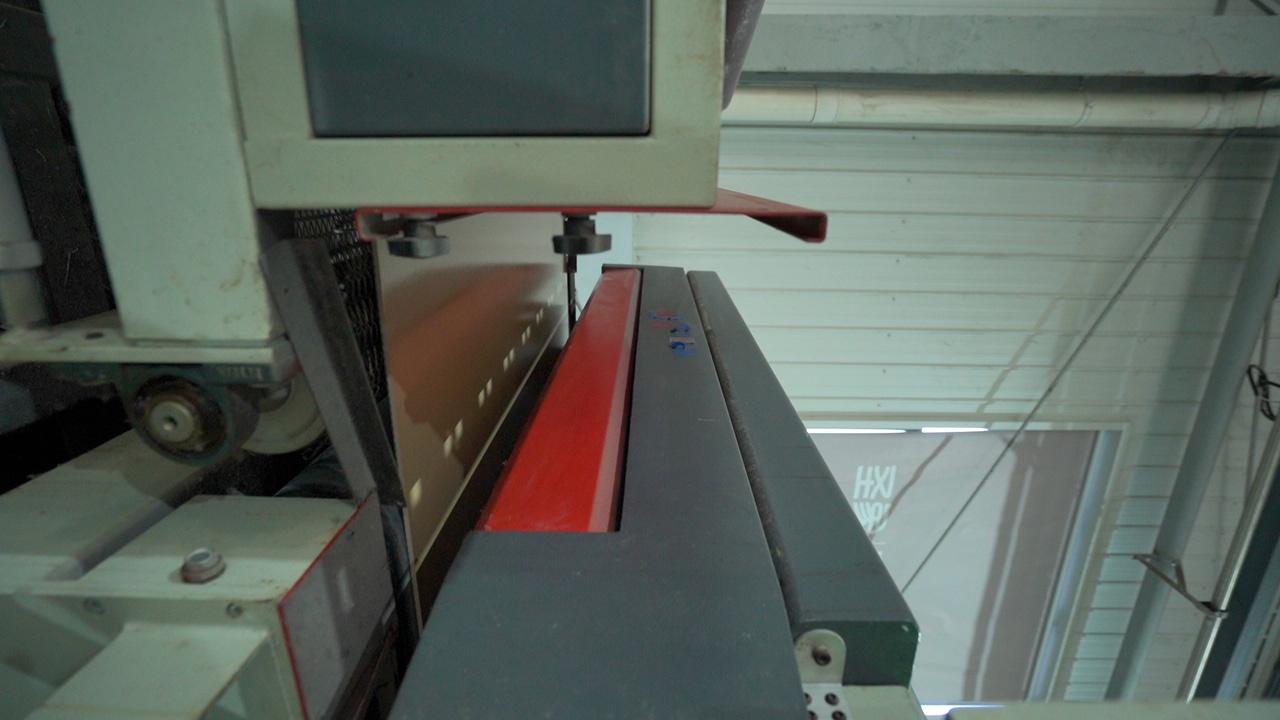
Volume production of decorative wall panel for a German retail and distributor programme covering indoor wall decoration and bathroom renovation.
Power Dekor Group is a manufacturer of floor covering and wall panel solutions founded in 1995, operating an 870,000 m² factory with an annual output of 88,000,000 m² and main markets in the EU and the USA. One of its German retail and distributor clients buys decorative wall panel for two jobs at once: indoor wall decoration and bathroom renovation, at a demand of 100,000 sqm per year.
At that volume, the purchase stops being a design decision and becomes a specification decision. Two constraints decided it — EU Class A2 fire performance and moisture resistance in wet rooms — and a third condition decided whether the specification could hold: whether the same panel could be delivered stably across a project life of 10 to 20 years.
Short answer: Silica Mineral Wall Panel model 8804 from Power Dekor Group is classified A2-s1, d0 to EN 13501-1 and is supplied with an attached fire report. It is 100% waterproof, with moisture movement of 0.06% in both the length and the width direction. SPC, HDF and WPC wall panels are Class B, which is why a Class A2 bathroom programme cannot be built on those substrates.
Problem definition: two constraints that eliminated most of the market
The German requirement was written around two lines that had to be met by the same panel, in the same room, for the same delivery cycle.
Constraint 1 — EU Class A2 reaction to fire. The decorative wall panel had to carry a Class A2 classification with documentation a specifier could file, not a supplier claim. The client's own wording was direct: the vast majority of materials on the market cannot meet Class A2.
Constraint 2 — moisture resistance. The same panel was going into bathroom space renovation, where the working condition is interior, humid and wet. A panel that only survives dry interiors disqualifies itself at the first shower room.
These two requirements pull in different directions in the decorative wall panel category. Class A2 performance is generally reached with mineral-based, largely inorganic compositions, while the bathroom end of the market has been developed mainly on polymer boards. That is why the usual bathroom shortlist — SPC, HDF and WPC wall panels — sits at Class B and stops there.
The realistic answer was therefore not a better version of a Class B board. It was a change of substrate, backed by a fire report and by dimensional data the client could check.
Industry background: what Class A2 means in a European bathroom
EN 13501-1 is the European classification standard for the reaction to fire of construction products, running from A1 (non-combustible) through to F. For decorative wall panels sold into European commercial, hospitality and multi-occupancy residential work, the classification sits inside the building's fire strategy rather than beside it: the wall lining is part of the compartment, and a Class B lining is not a substitute for a Class A2 lining in a specification that asks for one.
The category reality is uneven. In the supplied technical data, SPC wall panel (product ID 8321) is classified B-s3, d0 under EN 13501-1 and is used in the building decoration industry with supporting equipment such as sealant and edge trim profiles. SPC, HDF and WPC wall panels are all Class B. Buyers who assume that a waterproof bathroom board automatically satisfies a Class A2 clause discover the gap at document review, which is the most expensive moment to discover it.
Demand is not slowing down. The 3D wall panel segment alone was estimated at USD 815.02 million in 2025, with a forecast CAGR of 4.93% (360iResearch). Rising volume, however, does not change a fire classification, and it does not change the moisture behaviour of a substrate. Both still have to be proven product by product.
The solution: Silica Mineral Wall Panel model 8804
Silica Mineral Wall Panel model 8804 is a mineral-based decorative wall panel made from quartz, cement, pulp, lime and water. It is produced as both an interior wall panel and an exterior wall panel, and it is the product that resolved the German programme's two-constraint problem.
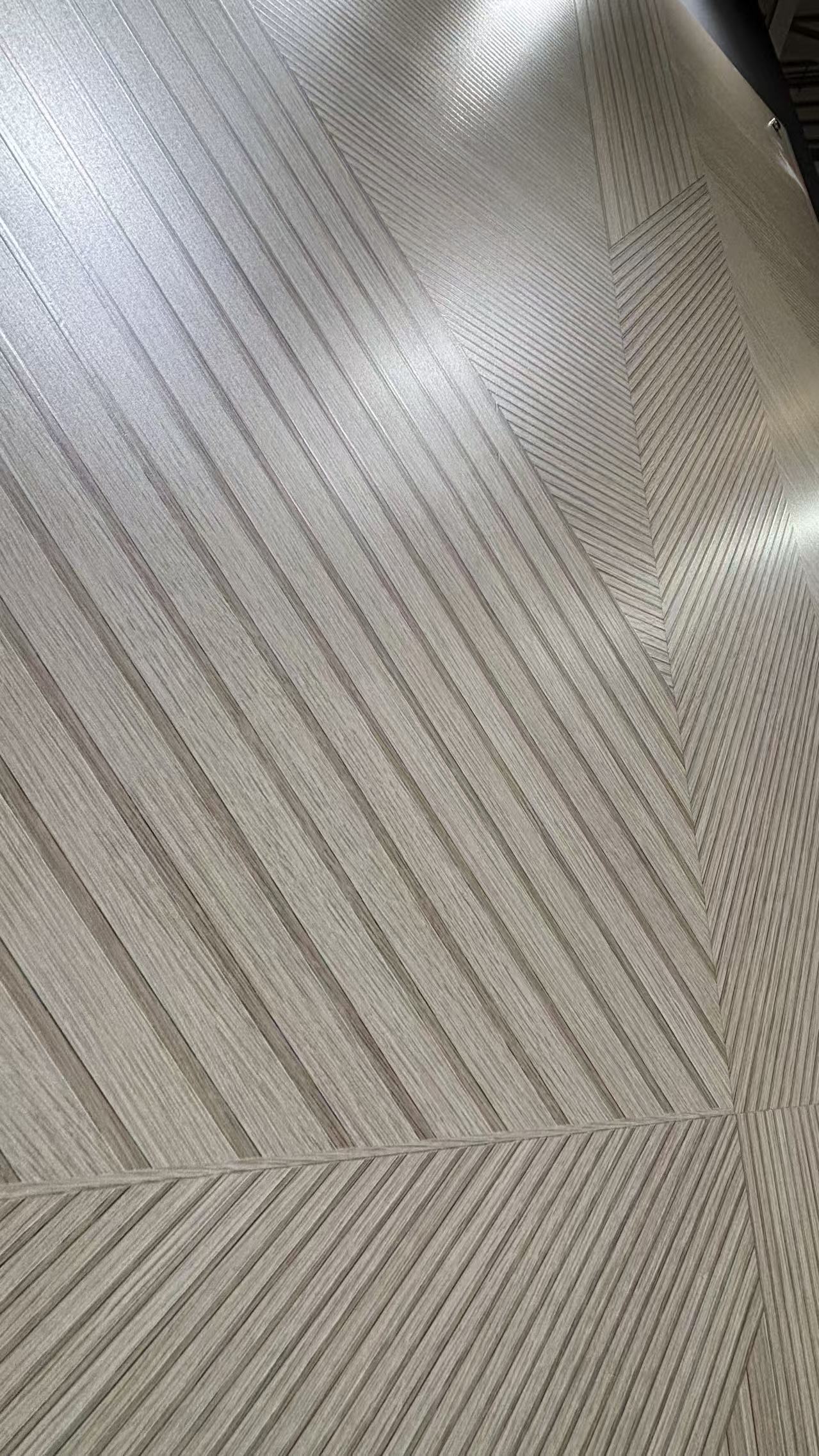
Silica Mineral Wall Panel with a 3D embossed wood-effect surface, one of the finishes available for indoor wall decoration.
Fire performance: A2-s1, d0 with a report
Model 8804 has a reaction to fire classification of A2-s1, d0. It has a fire rating of Class A2, supported by an attached report, and it complies with the EU fireproof Class A standard for bathroom and interior decorative wall panel applications. For a distributor that has to defend the specification to architects, contractors and insurers, the attached report matters as much as the class itself: it converts a marketing statement into a fileable document.
Moisture performance: 100% waterproof with 0.06% movement
Moisture movement is 0.06% in the length direction and 0.06% in the width direction. The panel is 100% waterproof and can be submersed in water; it shows no deformation after boiling at 100 °C, and a video of that test is available. For a bathroom renovation programme, those two numbers describe different risks: moisture movement governs whether joints and seams stay closed over time, and full water resistance governs what happens when water reaches the panel body rather than the surface.
Hygiene and material composition
Antibacterial testing to ISO 846:2019 Method A reported no growth apparent under the microscope. Asbestos content is negative. The panel is plastic-free, with material composition details available in the brochure. All raw materials are naturally sourced, and waste can be landfilled and return to nature — a point that matters to German retail clients who are asked about end-of-life handling by their own customers.
Weight, handling and fixing
Density is 1,050 kg/m³, compared with 2,000 kg/m³ for SPC wall panels. On a 100,000 sqm programme that difference is not cosmetic: it changes how panels are carried on site, how they are lifted against a wall during gluing, and how much manual handling risk sits in the installation crew's day.
Available sizes
| Length | 2,400 / 2,440 / 3,000 / 3,050 mm |
| Width | 1,200 / 1,220 mm |
| Thickness | 6 / 8 / 10 mm |
| Reaction to fire | A2-s1, d0 (EN 13501-1), report attached |
| Moisture movement | 0.06% (length) / 0.06% (width) |
| Water resistance | 100% waterproof; submersible; no deformation after boiling at 100 °C |
| Antibacterial test | No growth apparent under the microscope, ISO 846:2019 Method A |
| Asbestos content | Negative |
| Plastic content | None (plastic-free) |
| Material | Quartz, cement, pulp, lime, water |
| Density | 1,050 kg/m³ |
| Application | Interior wall panel and exterior wall panel |
Technical data for Silica Mineral Wall Panel model 8804 as supplied for the German programme.
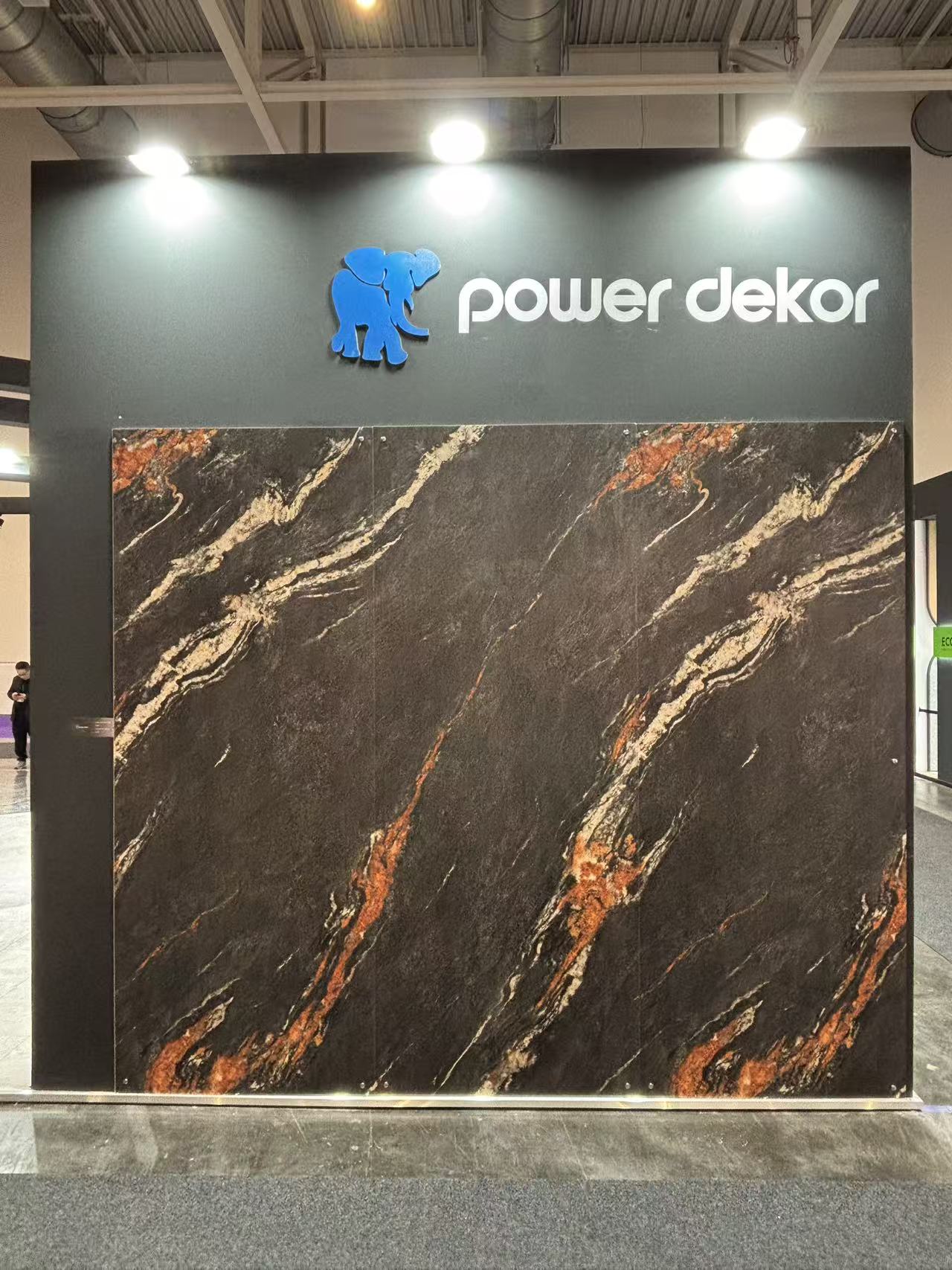
Matt surface finish. Surface choice affects the visual scheme; the fire and moisture classification stays the same.
Step-by-step: how the German programme was specified and delivered
- Lock the fire basis first, before colour selection. The specification was anchored on Class A2 with an attached report, not on a supplier statement. Because SPC, HDF and WPC wall panels are Class B, this single step removed most of the initial long list and stopped the client from designing a scheme around a substrate that could not pass document review.
- Test moisture behaviour against real bathroom conditions. The client reviewed the 0.06% moisture movement in both directions, the 100% waterproof claim, and the boiling test at 100 °C. The question they were answering was not whether the panel resists a splash, but whether it stays dimensionally stable in a wet room over a 10 to 20 year service life.
- Match sizes to the renovation workflow. Formats of 2,400 / 2,440 / 3,000 / 3,050 mm length, 1,200 / 1,220 mm width and 6 / 8 / 10 mm thickness were mapped to wall heights and to the cutting plan, so that fewer joints fall in visible bathroom zones.
- Confirm the volume can be held. Power Dekor Group runs a monthly capacity of 500,000 sqm, against the client's 100,000 sqm per year requirement, with OEM / ODM production, BOX / LABEL customization and 100% testing. Capacity here is a delivery-continuity argument, not a price argument: a distributor that commits to retailers cannot absorb a mid-year supply gap.
- Validate before committing the range. Samples and the fire report were used to check surface, weight and handling before the specification was written into the retail programme. Density of 1,050 kg/m³, against 2,000 kg/m³ for SPC wall panels, was assessed on site by the installers who would actually lift the panels.
- Run the delivery cycle. Production runs on a 30–45 day lead time with a minimum order quantity of 500 sqm and remote after-sales support, which is what makes a repeating 100,000 sqm/year schedule workable rather than a one-off shipment.
Installation in wet areas: the details that decide the outcome
The panel is installed by gluing to the wall. In a bathroom, the sequence matters as much as the product:
- Level the wall with a laser level meter, divide the surface into blocks according to panel size and mark the layout in advance; pre-fit unglued panels to confirm the calculation.
- Cut with a table saw or handsaw using a diamond saw blade, decorative side facing up. All cutting and drilling is done before adhesive is applied.
- Mark socket and switch positions, then cut with a diamond grit driller or diamond grit jigsaw.
- Apply structural adhesive evenly to the back of the panel, align to the marked lines and work upwards from the bottom, then continue with the locking system.
- After every four to five panels, re-check horizontally and vertically with the level laser so deviation does not accumulate.
- Press across the full panel surface to remove air pockets and secure adhesion.
- At internal and external corners, assemble metal trims to the panel before fitting to the wall.
- In wet bathroom areas, metal trims are not applicable. Seal all joints — panel to ceiling, panel to floor and the rest — with silicone sealant for water insulation.
Panels should be handled carefully at the edges during movement on site.
Use cases: where this specification repeats
Germany — retail and distributor programme, 100,000 sqm per year. Application: indoor wall decoration and bathroom space renovation, over a project duration of 10 to 20 years. The result recorded for this project was moisture-proof performance, stable project delivery and compliance with the EU standard, with the panel selected for its suitability to humid indoor environments and for quick renovation cycles.
Spain — project contractor, 50,000 sqm per year. Application: bathroom and other interior decorative wall panel work over a 10 year duration. The same two constraints applied, with the contractor recording moisture-proof performance, stable project delivery and compliance with the EU fireproof Class A standard.
The pattern across both projects is consistent: the specification is driven by the wet room, and the volume is driven by the retail or contracting channel behind it. A distributor selling into bathrooms needs one panel that satisfies the fire clause and the moisture clause at the same time, because splitting the range across two substrates doubles the stock, the training and the warranty surface.
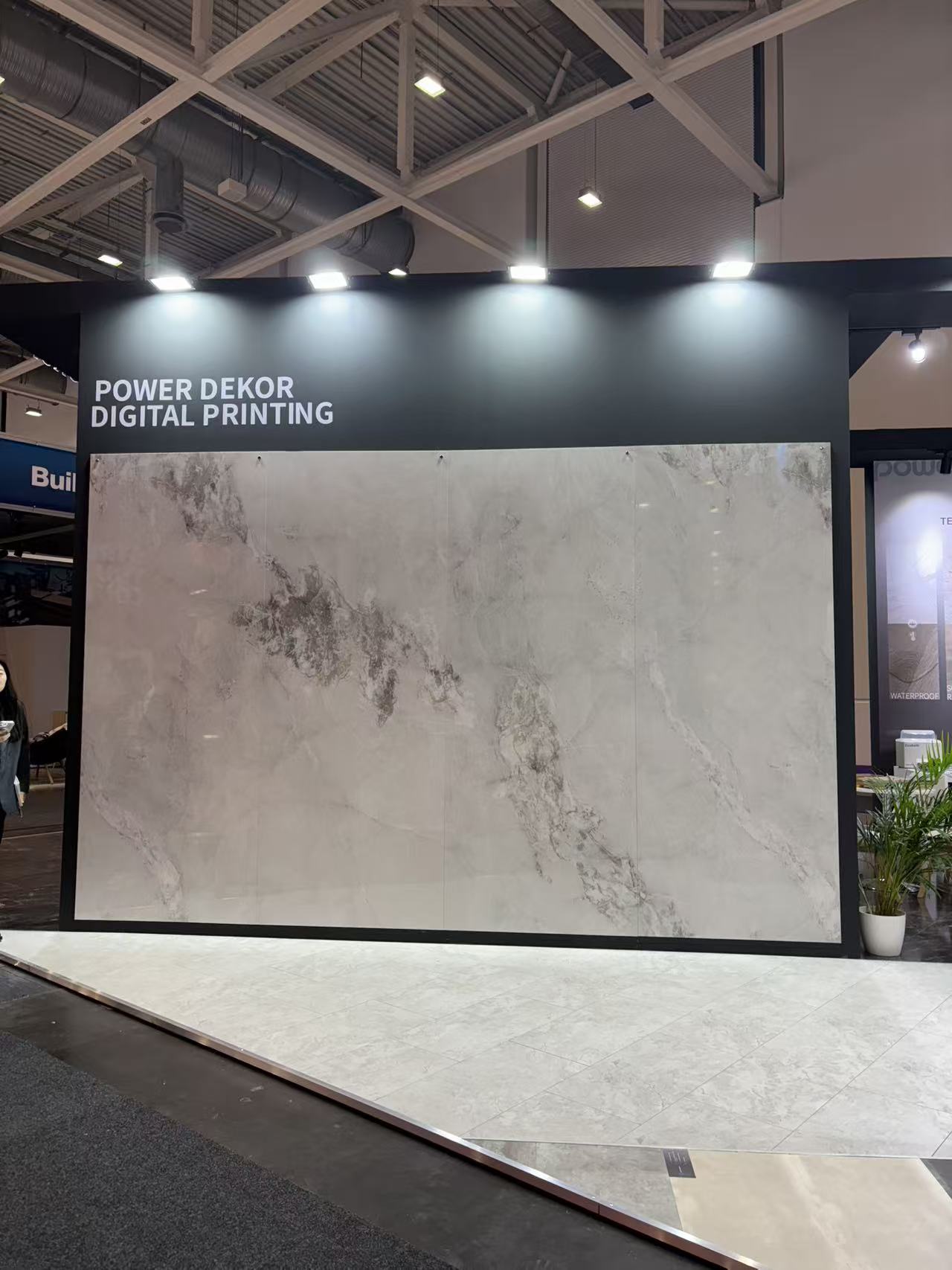
High-gloss surface finish. Finish selection is independent of the A2-s1, d0 classification and the 0.06% moisture movement.
Comparison: model 8804 against the usual bathroom substrates
| Property | Silica Mineral Wall Panel 8804 | SPC wall panel 8321 | HDF wall panel | WPC wall panel |
|---|---|---|---|---|
| Reaction to fire (EN 13501-1) | A2-s1, d0 | B-s3, d0 | Class B | Class B |
| Fire report attached | Yes | Not stated in supplied data | Not stated in supplied data | Not stated in supplied data |
| Density | 1,050 kg/m³ | 2,000 kg/m³ (SPC wall panel) | Not covered by supplied data | Not covered by supplied data |
| Water behaviour | 100% waterproof; submersible; no deformation after boiling at 100 °C | Moisture content 0.02%; shrinkage <0.002%; curling ≤0.2 mm | Not covered by supplied data | Not covered by supplied data |
| Moisture movement | 0.06% length / 0.06% width | Not stated in supplied data | Not covered by supplied data | Not covered by supplied data |
| Plastic content | None (plastic-free) | Stone plastic composite | Not covered by supplied data | Not covered by supplied data |
| Asbestos content | Negative | Not stated in supplied data | Not covered by supplied data | Not covered by supplied data |
| Use stated in supplied data | Interior and exterior wall panel | Building decoration; bathroom use supported by waterproof, easy-clean finish | Not covered by supplied data | Not covered by supplied data |
Only supplied and verified data are compared. Cells without data are marked rather than estimated.
The table explains the decision in one line: the only row that separates the options for a Class A2 bathroom specification is the first one. SPC wall panels remain a valid, cost-oriented choice for bathrooms without a Class A2 clause — the panel is waterproof with an easy-clean finish and a lower density profile is not claimed for it, since SPC is heavier at 2,000 kg/m³. Where the clause exists, the substrate has to change.
Frequently asked questions
Does model 8804 meet the EU Class A2 fire requirement for bathrooms and interior walls?
Yes. Silica Mineral Wall Panel model 8804 has a reaction to fire classification of A2-s1, d0 under EN 13501-1, supported by an attached report, and complies with the EU fireproof Class A standard for bathroom and interior decorative wall panel applications. For comparison, SPC, HDF and WPC wall panels are Class B; SPC wall panel 8321 is classified B-s3, d0.
How does the panel behave under continuous bathroom moisture?
The panel is 100% waterproof and can be submersed in water, with no deformation after boiling at 100 °C. Moisture movement is 0.06% in both the length and width directions, which is the figure to check against joint design in a wet room. Installation in wet areas requires silicone sealant at all joints — panel to ceiling, panel to floor and the rest — and metal trims are not applicable there.
What order volume and capacity sit behind a 100,000 sqm/year programme?
Production is OEM / ODM with BOX / LABEL customization, a minimum order quantity of 500 sqm and a monthly capacity of 500,000 sqm, with 100% testing and remote after-sales support. The German requirement of 100,000 sqm per year is set against that monthly capacity so that the annual schedule can absorb a peak without a supply gap. Commercial terms are quoted per project.
Can the panel be validated before the specification is written?
Yes. The fire report for the A2-s1, d0 classification is attached to the product documentation, a video of the boiling test is available, and samples can be requested so that surface, weight and handling — at 1,050 kg/m³ against 2,000 kg/m³ for SPC wall panels — are checked by the people who will install the panels.
What lead time applies to a repeating bathroom programme?
Lead time is 30–45 days at a minimum order quantity of 500 sqm, which is what allows a repeating 100,000 sqm/year schedule to be planned across a 10 to 20 year project life rather than ordered shipment by shipment. To start a project review, request a sample or a quotation from Power Dekor Group, or download the brochure for material and finish details.
Conclusion
The German programme did not fail on aesthetics. It was resolved on two hard lines: A2-s1, d0 fire classification with an attached report, and 100% waterproof performance with 0.06% moisture movement in both directions. Everything else — the 2,400 / 2,440 / 3,000 / 3,050 mm lengths, the 1,200 / 1,220 mm widths, the 6 / 8 / 10 mm thicknesses, the density of 1,050 kg/m³, the ISO 846:2019 Method A antibacterial result and the negative asbestos content — supports those two lines rather than replacing them.
For distributors and contractors working on humid bathroom interiors with a Class A2 clause, the practical rule is simple: check the fire classification first, because SPC, HDF and WPC wall panels stop at Class B; then check moisture movement, because a waterproof surface and a dimensionally stable panel are not the same claim.
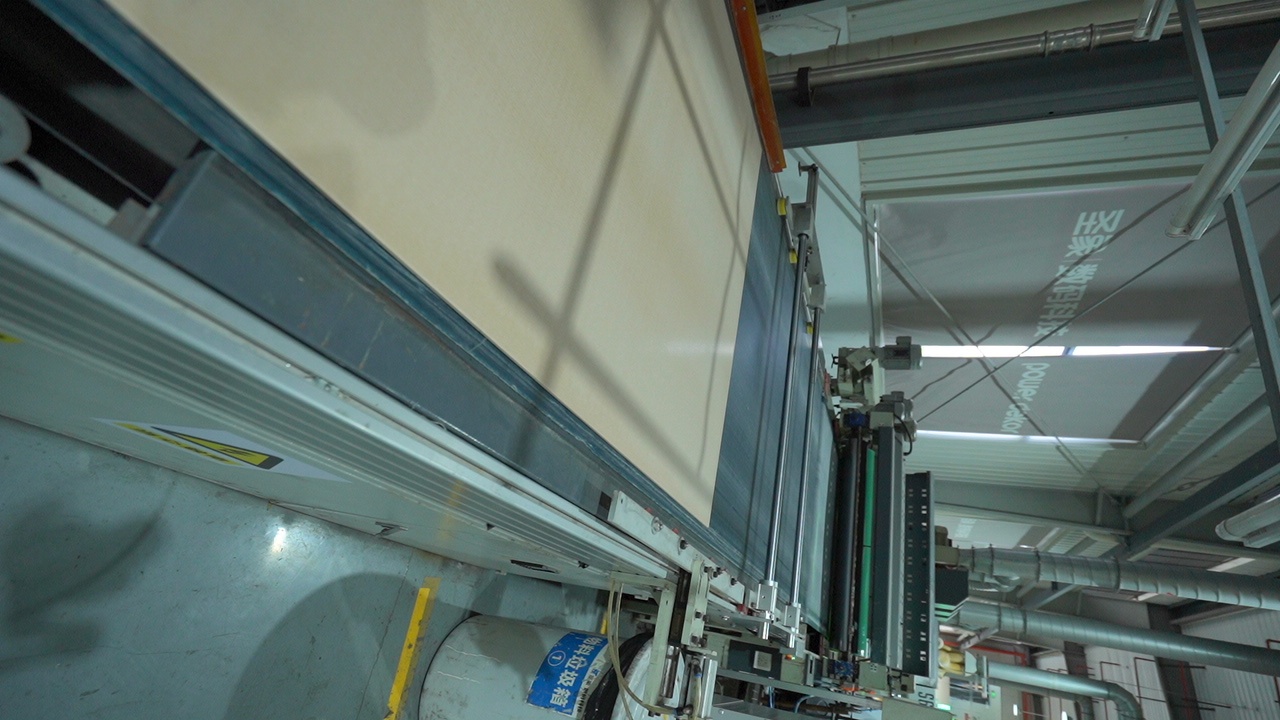
Panel production capacity of 500,000 sqm per month supports repeating retail and distributor programmes.
Next step: sample, report and quotation
Power Dekor Group supplies Silica Mineral Wall Panel model 8804 for bathroom and interior decorative wall panel projects, with the A2-s1, d0 fire report, technical data and samples available on request.
Contact: Luna — lunasun@powerdekorgroup.com · Tel / WhatsApp: +86 18817368868 · Message on WhatsApp
Website: www.powerdekorgroup.com · Brochure download: Power Dekor product brochure (PDF)
Have Questions or Need More Details?
Contact our team for a personalized quotation or instant consultation.
Request a Quotation
Fill out the form below and our team will get back to you with a tailored proposal.
WhatsApp Direct Chat
Prefer to chat in real-time? Message us on WhatsApp for instant assistance & quick answers.
- Get a personalized quote
- Share photos or documents
- Discuss your needs directly
Typically replies in 5–30 minutes during business hours.