
Custom Decorative Wall Panel OEM: A Buyer's Execution Guide
Custom Decorative Wall Panel OEM: A Buyer's Execution Guide
A custom decorative wall panel program is decided long before the container is loaded. It is decided by how precisely the decorative surface, the substrate, the fire classification, the packaging and the acceptance criteria are specified, sampled and tested. Power Dekor Group, a manufacturer of flooring and wall panels founded in 1995 and headquartered in Shanghai, produces decorative wall panels in OEM and ODM modes with a 500 sqm minimum order quantity, a 30–45 day production lead time and 500,000 sqm of monthly production capacity. This guide is written for importers, distributors, project contractors and brand owners who are evaluating a Chinese OEM manufacturer and preparing to execute a first or repeat order.
The question it answers is narrow and practical: how do you take a design idea or a project requirement and turn it into a repeatable, compliant, installable wall panel order? Every step of that chain has a measurable consequence — in cost, in lead time, or in whether the finished wall passes inspection.
Why Custom Wall Panel Programs Fail Before Production Starts
Most problems in custom decorative wall panel sourcing are not manufacturing defects. They are specification gaps that only become visible after installation. Six of them recur across OEM and ODM projects.
- Decoration method chosen without checking pattern continuity. Panels finished with film carry a design limited by the size of the film, while digital print panels can carry any design, including a continuous pattern running across as many as ten panels in one sequence. A wall that must read as one uninterrupted graphic cannot be produced as a film panel.
- Substrate and fire class treated as the same decision. Reaction-to-fire classification under EN 13501-1, the European standard that grades commercial wall panels from A1 (non-combustible) to F, is determined largely by the substrate. SPC wall panels are classified B-s3,d0; silica mineral wall panels are classified A2-s1,d0. Choosing the cheaper substrate first and the fire requirement afterwards usually forces a redesign.
- Wet-area detailing left to the installer. In bathrooms and other wet areas, metal trims are not applicable; joints between panels, and between panels and ceiling or floor, must be sealed with silicone sealant for water insulation.
- Exterior use assumed from an interior verification. Compliance documents are product- and thickness-specific. The CE verification held for the silica mineral wall panel covers internal use as wall coverings at 6–8 mm thickness. A facade or exterior cladding requirement sits outside that stated scope and needs its own project evaluation.
- Container economics ignored at the sampling stage. The commercial structure is 500 sqm per SKU and one 20GP container per order, with no more than four SKUs per container; LCL shipments increase the price. A design brief that assumes ten patterns in one container will not survive quotation.
- Acceptance criteria never written down. Without a defined pre-shipment test, the buyer's only leverage point arrives after the goods are on the water.
What the Decorative Wall Panel Market Looks Like in 2026
Market data on this category is unusually definition-sensitive, and that affects how a buyer should read supplier claims. Coherent Market Insights projects the global decorative panels market to reach roughly USD 39.35 billion by 2026, driven by urbanization and interior renovation demand, and estimates laminate panels at close to half of that market (45.4%) by 2026. Reed Intelligence reports that Asia Pacific held 43.6% of the global wall panels market in 2025 and is expected to remain the fastest-growing region.
The gap between sources is itself informative. Wall panel figures and decorative panel figures diverge because “decorative panels” in some datasets includes furniture and cabinet laminates, while “wall panels” is restricted to building cladding. The consequence for a buyer is straightforward: when a supplier quotes a market size, check which product scope the number covers before using it in a business case.
Two sub-segments are worth separating when planning a range. The 3D wall panel segment was estimated at USD 815.02 million in 2025 with a forecast CAGR of 4.93% (360iResearch), which reflects demand for sculpted visual effects rather than flat finishes. Separately, SPC wall panels are noted for fire retardancy standards such as B1 grade together with zero formaldehyde and waterproof properties. In commercial and public-space projects across Europe, EN 13501-1 classification is the gating requirement rather than a differentiator: it determines whether a panel may be specified at all.
The Capability Package: What an OEM Partner Must Provide
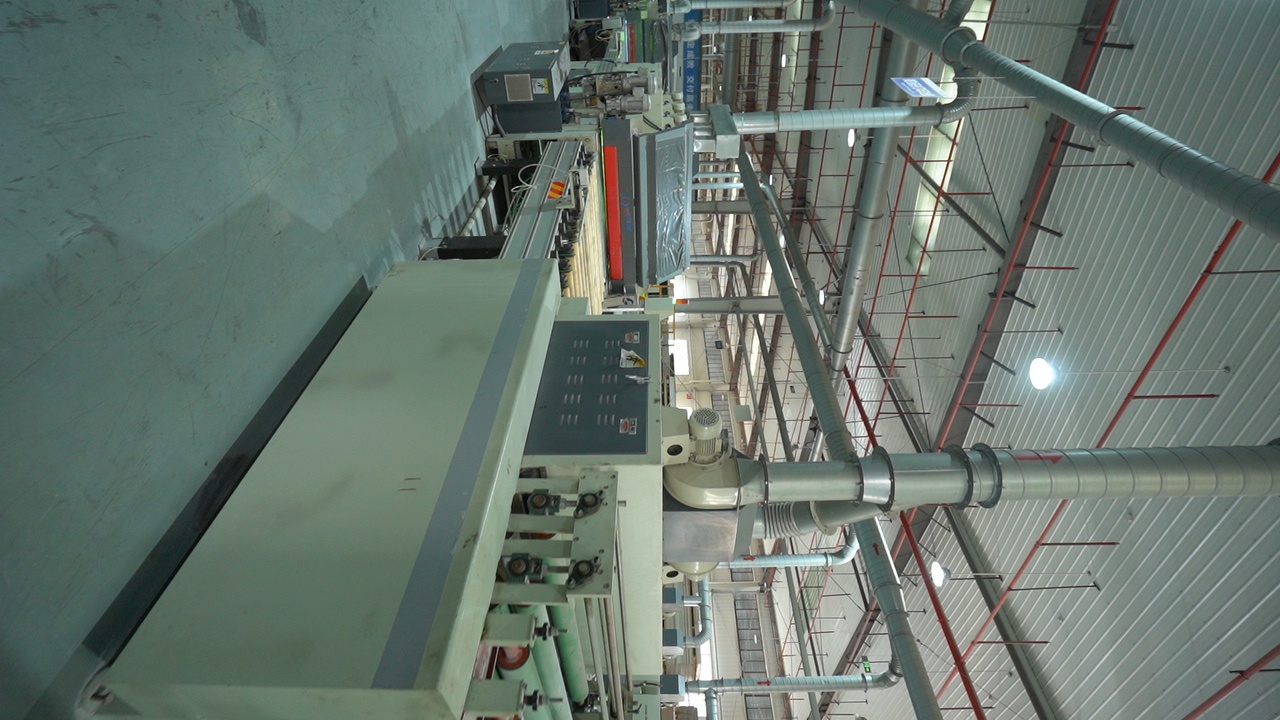
Capability in this category is not a single attribute. It is a combination of production capacity, customization scope, quality control and documentation that must all be present before a buyer can commit to a specification.
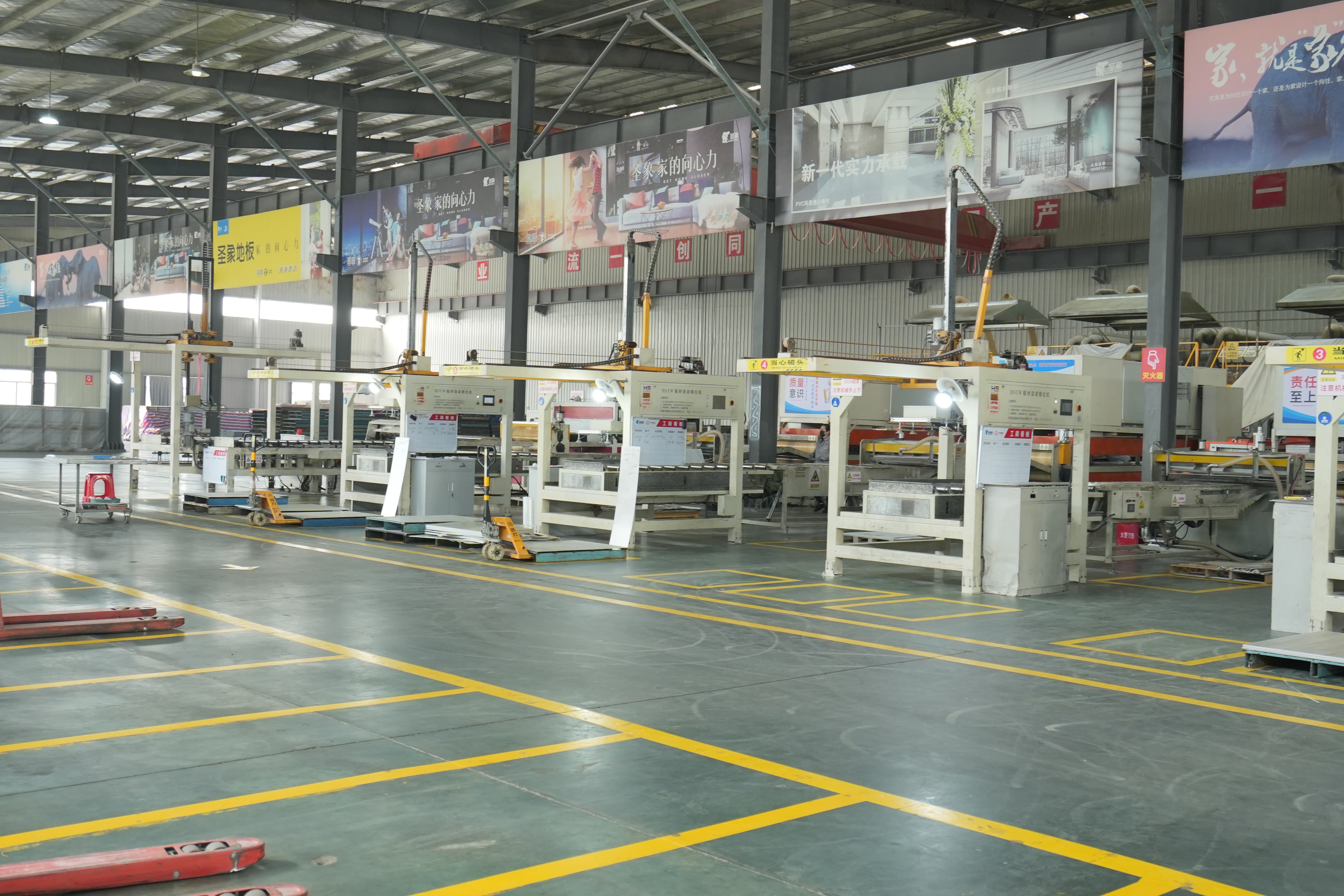
Power Dekor Group operates as a global provider of floor covering and wall panel solutions, with a portfolio covering resilient flooring, laminate, wood, accessories and wall panels, and is a member of Dare Global Group. The group reports a factory footprint of 870,000 m², more than 20,000 employees, an annual output of 88,000,000 m² across its portfolio, and an R&D team of 495 engineers. Its stated sales network covers North America, South America, Europe, Oceania, Asia and the Middle East, with EU and USA among its main markets.
For wall panel orders specifically, the customization capability includes:
- OEM and ODM production modes for custom production, so a buyer can supply a finished design or a design brief.
- Packaging customization covering box and label customization, which is the point at which a private-label program becomes viable.
- Monthly production capacity of 500,000 sqm, with a typical production lead time of 30–45 days.
- Minimum order quantity of 500 sqm, which also applies to custom orders.
- 100% testing within quality control, with acceptance based on pre-shipment testing.
- Remote after-sales support after delivery.
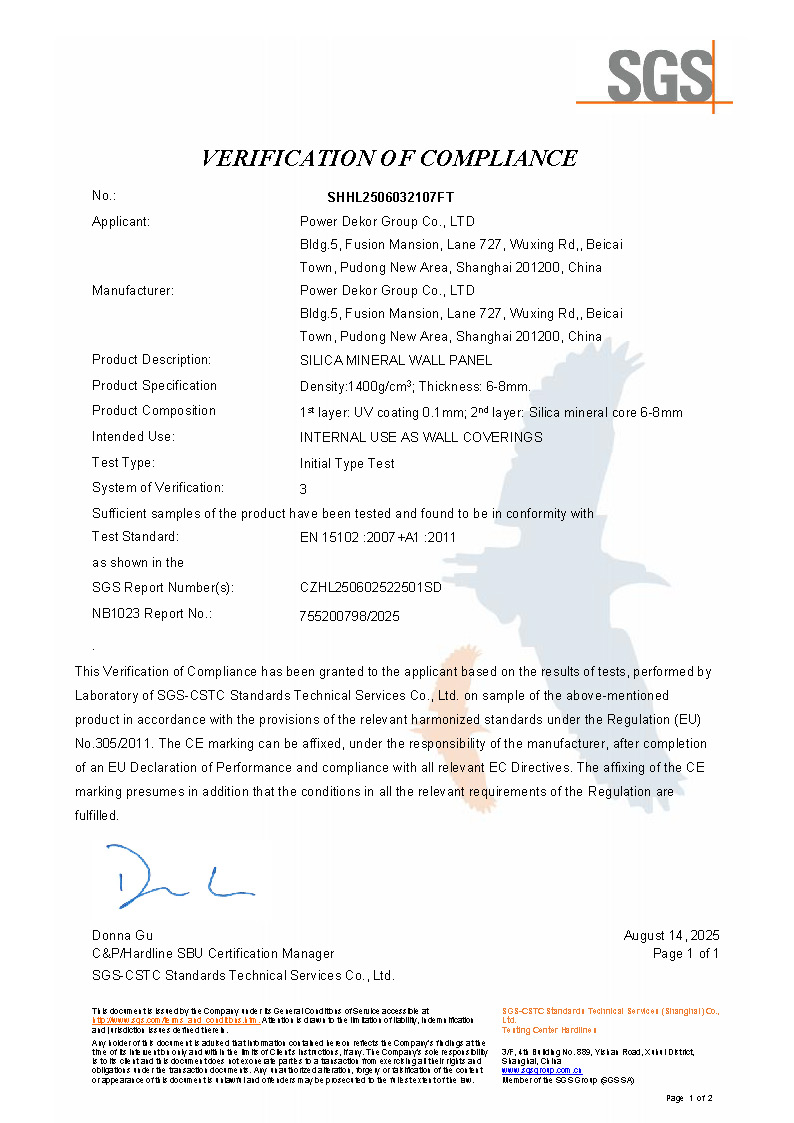
Documentation is the second half of the capability package, and it is where generic suppliers separate from industrial ones. Two verifications are held for the wall panel range. The silica mineral wall panel holds a Verification of Compliance (CE Verification), certificate number SHHL2506032107FT, issued by SGS‑CSTC Standards Technical Services Co., Ltd. on 14 August 2025 to EN 15102:2007+A1:2011, scope: SILICA MINERAL WALL PANEL, for internal use as wall coverings, thickness 6–8 mm. The SPC wall panel holds a CE Verification, certificate number 230608011SHF-001, issued by Intertek on 23 January 2024 to EN 13501-1:2019, scope: SPC wall panel, thickness 4 mm.
Substrate Selection: SPC Wall Panel vs Silica Mineral Wall Panel
Substrate choice is the single decision that constrains everything downstream — fire class, weight, moisture behaviour, installation method and price position. The table below compares the two wall panel substrates documented in the current range, using published product parameters only.
| Parameter | SPC Wall Panel | Silica Mineral Wall Panel |
|---|---|---|
| Material composition | Stone plastic composite | Quartz, cement, pulp, lime and water (no plastic) |
| Available size | 2400/2440/3000/3050 × 1200/1220 × 4/5/6 mm | 2400/2440/3000/3050 × 1200/1220 × 6/8/10 mm |
| Decoration options | Digital print, film | Interior and exterior wall panel applications |
| Reaction to fire classification | B-s3,d0 (EN 13501-1:2019, CE verification for 4 mm) | A2-s1,d0 (CE verification scope: internal use as wall coverings, 6–8 mm) |
| Density | 2.134 g/cm³ | 1050 kg/m³ (as reported for a European project reference) |
| Moisture behaviour | Moisture content 0.02%; dimensional stability: shrinkage <0.002%, curling ≤0.2 mm | Moisture movement 0.06% in both length and width directions; reported as fully waterproof and dimensionally stable after boiling at 100℃ |
| Surface performance | Micro-scratch resistance MSR-A1; dry heat resistance rating 5; wet heat resistance rating 5; stain resistance grade 5 | Antibacterial test: no growth apparent under the microscope, ISO 846:2019 Method A |
| Asbestos content | Not stated in the document set reviewed | Negative |
| Typical fit | Private bathrooms and interiors where price matters more than fire class | Public and commercial spaces with fire requirements; surfaces intended to read more like porcelain |
All values above are taken from the product parameter and certification documents for the respective panels. They are material specifications, not project approvals; a given project must still be checked against its own regulatory requirements.
Decoration Method: Film vs Digital Print
Once the substrate is fixed, the next decision is how the decorative surface is produced. The two available routes behave differently in design freedom and cost, and this is the point where most custom design briefs are either enabled or ruled out.
| Decision factor | Film wall panels | Digital print wall panels |
|---|---|---|
| Design freedom | Design is limited by the size of the film | Design can be anything the buyer specifies |
| Continuous patterns | Not achievable beyond the film repeat | A continuous pattern can run across as many as ten panels in one sequence |
| Cost position | Lower price | Higher price, justified by design scope |
| Recommended for | Cost-sensitive buyers with no requirement on the number of design faces | Buyers with stronger design requirements or brand-specific artwork |
The practical reading of this table is that the decoration method should be chosen per SKU, not per order. A distributor building a mixed range can carry standard film panels as the volume line and use digital print for the hero designs and any continuous graphic feature walls, which keeps the average cost of the container under control.
Step-by-Step: Executing a Custom Decorative Wall Panel Order
Execution follows eight stages. Each stage closes a specific risk, and skipping one simply moves it downstream.
- Define the application before the product. Establish whether the panel is for interior or exterior use, whether the area is wet, and what fire classification the project requires. This single step eliminates most of the failure modes described earlier, because it decides the substrate and the documentation set.
- Choose the substrate and format. Match SPC or silica mineral to the requirement, then fix width, length and thickness from the available size ranges. Thickness is not cosmetic here: the CE verification for the silica mineral panel is tied to 6–8 mm, and the SPC verification to 4 mm.
- Choose the decoration method and supply artwork. Confirm whether the design must be continuous. If it must, specify digital print and provide artwork at the correct scale so that the panel sequence can be laid out in advance.
- Approve the sample against written criteria. Sample validation should test the attributes the project actually depends on — moisture behaviour, surface performance, colour consistency and joint appearance — rather than visual impression alone.
- Fix the commercial terms. Confirm MOQ (500 sqm per SKU, one 20GP per order, maximum four SKUs per container), delivery terms (FOB), payment terms (TT with 30% in advance and 70% balance against document copies, or L/C at sight), and note that LCL shipments increase the price.
- Place the order and schedule production. Production lead time is typically 30–45 days, against a monthly capacity of 500,000 sqm.
- Verify before shipment. Acceptance is based on pre-shipment testing, and quality control is carried out at 100%. This is the stage where packaging customization — box and label — is confirmed against the approved artwork.
- Plan installation and after-sales. Confirm the fixing method and the accessory list with the panels, and register the remote after-sales support channel for the installer.
Installation requirements that belong in the specification
Installation is part of the specification because it determines which accessories must be ordered with the panels. The documented method is a gluing method: the wall is levelled and divided into blocks marked with a pencil, panels are pre-fitted dry to verify the layout calculation, and a table saw or handsaw with a diamond blade is used to cut edge blocks, with the decorative side facing up. Cut-outs for sockets and switches are made with a diamond grit driller or jigsaw before adhesive is applied. Structural adhesive is applied to the back of each panel, and panels are set from the bottom upwards against pre-marked lines, then locked into the next panel. After every four to five panels, horizontality and verticality are rechecked, and the full surface is pressed in all directions to remove air pockets.
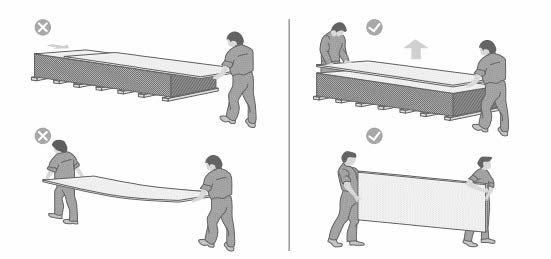
Two details change the accessory list. At internal and external corners, metal trims are assembled with the panels without gluing or nailing. In wet areas such as bathrooms, metal trims are not applicable, and all joints — between panels and between panels and ceiling or floor — must be sealed with silicone sealant for water insulation. Buyers should also note the handling instruction: panels must be moved carefully, particularly at the edges.
Use Cases: How Two European Buyers Specify These Panels
Two documented European references show how the specification logic plays out in practice, and why the substrate decision dominates the rest.
The first is a retail and distributor buyer in Germany running 100,000 sqm per year for indoor wall decoration and bathroom space renovation, with an intended service life of 10–20 years. The requirement set was moisture-proof performance, stable project delivery and compliance with the applicable EU standard. The selected panels are used in a humid indoor environment where quick renovation and straightforward installation matter, and both SPC wall panels and silica mineral wall panels appear in that reference.
The second is a project contractor in Spain running 50,000 sqm per year for bathroom and other interior decorative wall panel applications over a 10-year horizon. This project required a Class A2 fire rating, a level most materials on the market cannot reach — SPC, HDF and WPC panels are Class B in this classification. The remaining requirements were dimensional stability (100% waterproof, submersible without deformation, and no deformation after boiling at 100℃), plastic-free composition, naturally sourced raw materials with waste suitable for landfill, and low weight, with the silica mineral panel at 1050 kg/m³ against roughly 2000 kg/m³ for SPC wall panels.
The pattern is consistent: where the fire class or the weight of the installed system drives the project, the substrate decision is made first and the decorative design follows it. Where the project is a price-driven private bathroom renovation, the reverse order is usually more efficient.
Frequently Asked Questions
Does a Chinese OEM decorative wall panel manufacturer hold EU compliance verification, and what does the scope actually cover?
Power Dekor Group holds two CE verifications for its wall panel range, and both are product- and thickness-specific. The silica mineral wall panel holds certificate number SHHL2506032107FT, issued by SGS‑CSTC Standards Technical Services Co., Ltd. on 14 August 2025 to EN 15102:2007+A1:2011, covering SILICA MINERAL WALL PANEL for internal use as wall coverings at 6–8 mm thickness. The SPC wall panel holds certificate number 230608011SHF-001, issued by Intertek on 23 January 2024 to EN 13501-1:2019, covering SPC wall panel at 4 mm thickness. Because the scope names the product, the application and the thickness, a verification document should always be read against the exact configuration being ordered, and exterior applications fall outside the interior scope stated for the silica mineral panel.
Can the design and the packaging be customized for our own brand?
Yes. Production is offered in OEM and ODM modes for custom production, and packaging customization covers box and label customization, which is what allows a distributor or brand owner to sell under its own identity. On the panel surface, digital print panels can carry any design the buyer specifies, including a continuous pattern running across as many as ten panels in one sequence. Film panels are limited by the size of the film and are positioned at a lower price, making them suitable for cost-sensitive customers with no specific requirement on the number of design faces.
Which panel should be used in a bathroom, and which in a public space with fire requirements?
The choice follows the fire requirement rather than the room name. For a private bathroom where price matters more, SPC wall panel is the recommended fit; it has a moisture content of 0.02%, shrinkage below 0.002%, curling of 0.2 mm or less, and a B-s3,d0 reaction to fire classification. Where the space is public and fire-rated, the silica mineral wall panel is the better fit: it is classified A2-s1,d0, contains no plastic, tests negative for asbestos, and produces a surface that reads more like porcelain. Both substrates are installed with the same gluing method, but joints in wet areas must be sealed with silicone sealant because metal trims are not applicable there.
What are the minimum order quantity, payment and delivery terms?
The minimum order quantity is 500 sqm per SKU, with a minimum of one 20GP container per order and no more than four SKUs per container; LCL shipments increase the price. Delivery is arranged on FOB terms. Payment is by TT with 30% in advance and 70% balance against document copies, or by L/C at sight. Acceptance is based on pre-shipment testing. Buyers planning a wide pattern range should map their SKU count against the four-SKU container limit before finalizing the design set, because that limit, not the 500 sqm MOQ, is usually the binding commercial constraint.
How long does production take, and what is the next step to validate a custom order?
Typical production lead time is 30–45 days against a monthly production capacity of 500,000 sqm, with 100% quality control and pre-shipment testing as the acceptance basis. The practical next step is to validate the specification before committing to volume: request a sample of the intended substrate, thickness and decoration method, confirm that the CE verification scope matches the configuration, and then convert to a quotation. Samples and quotes for custom decorative wall panel programs can be requested through Power Dekor Group at powerdekorgroup.com, by email to lunasun@powerdekorgroup.com, or on WhatsApp at +86 18817368668.
Next Step: Samples, Quotes and the Full Product Catalogue
The full technical range, including SPC wall panel sizes, silica mineral wall panel formats, decoration options and certification documents, is available in the Power Dekor Group brochure. Download it to compare configurations against your project requirements, then send your application, size and decoration brief for a sample and quotation.
Download the Power Dekor Group product brochure (PDF)
Contact: Luna · Email: lunasun@powerdekorgroup.com · Tel / WhatsApp: +86 18817368668 · Bldg. 5, Fusion Mansion, Lane 727, Wuxing Rd., Pudong District, Shanghai 201204, China.
Conclusion
Custom decorative wall panel sourcing from a Chinese OEM manufacturer is an execution discipline, not a catalogue exercise. The sequence that works is consistent: fix the application first (interior or exterior, wet or dry, fire-rated or not), let that determine the substrate and its verification scope, choose film or digital print according to whether the design must continue across panels, then lock the commercial envelope of 500 sqm per SKU within a single 20GP container holding no more than four SKUs. Sample approval and pre-shipment testing are the two points where risk is actually retired, and the 30–45 day lead time is predictable only when the specification has been frozen before it starts.
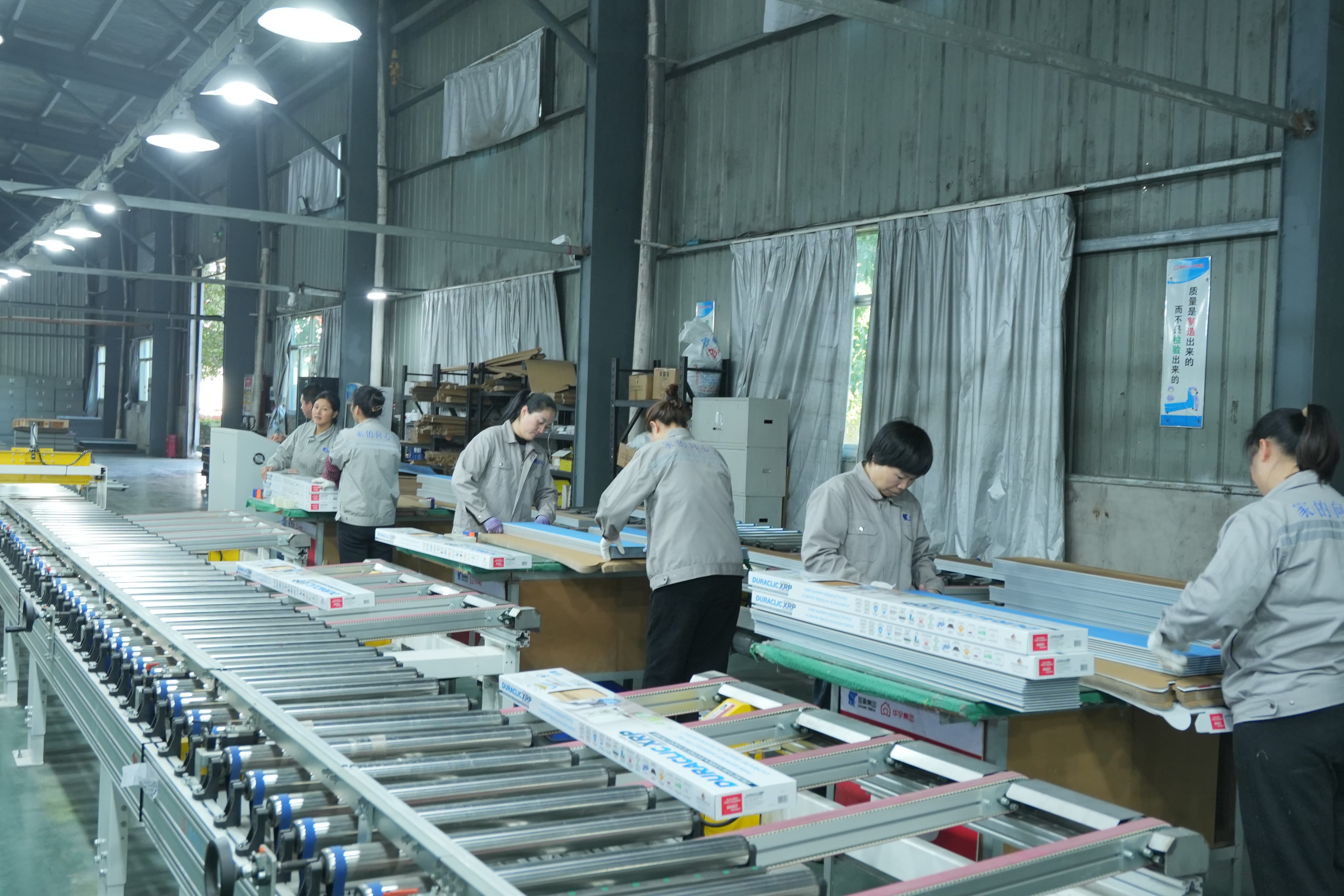
Power Dekor Group supplies this process with OEM and ODM production, box and label packaging customization, 500,000 sqm of monthly capacity, 100% quality control testing and a documented EU verification set for both the SPC and silica mineral wall panel substrates. Buyers who arrive with a defined application, a defined fire requirement and a defined design brief can move from sample to container without redesigning the order mid-production.
Have Questions or Need More Details?
Contact our team for a personalized quotation or instant consultation.
Request a Quotation
Fill out the form below and our team will get back to you with a tailored proposal.
WhatsApp Direct Chat
Prefer to chat in real-time? Message us on WhatsApp for instant assistance & quick answers.
- Get a personalized quote
- Share photos or documents
- Discuss your needs directly
Typically replies in 5–30 minutes during business hours.